Get in touch
Top 10 Heritage Sites in India List August 2023 Updated
The 1972 UNESCO World Heritage Convention recognized different cultural and natural sites across the world. After the most recent addition to UNESCO World Heritage Sites, India now has 38 World Heritage Sites, making India the world’s sixth-biggest site! Thirty cultural sites, seven natural places, and one mixed by UNESCO are recognized.
- Taj Mahal, Agra – The Taj Mahal has been erected by Emperor Shah Jahan in remembrance of his wife Mumtaj Mahal, one of the Seven Wonders of the World. Mughal White Marble architecture. In 1653, the cost projected at 32 million Indian rupees, to 58 billion Indian rupees, was finished. It is the greatest example of Mughal architecture in the world and is known in India as the “Jewel of Muslim Art.” This monument is arguably the best recognized worldwide for its connection to Indian patrimony. In 1631, in remembrance of Mumtaz Mahal his wife died on 17 June of that year, while giving life to Gauhara Begum, her 14th baby, the Taj Mahal had been commissioned by Shah Jahan. Construction began in 1632 and in 1648 the tomb was completed and five years later the nearby structures and garden were completed. The Imperial court which documents Shah Jahan’s complaint after Mumtaz Mahal’s death is an example of the love story that inspired the Taj Mahal.
You can contact to Taj Mahal, Agra through website https://www.tajmahal.gov.in/ and you can call on 0562 222 7261
- Khajuraho, Madhya Pradesh – Khajuraho is a renowned UNESCO World Heritage Site in India, located in Madhya Pradesh. Khajuraho is a unique landmark recognized for the Hindu and Jain Temples group 175 miles to the southeast of Jhansi. It is noted for its symbolism and sensual figures and sculptures in the Nagara style. These sensual human and animal stone sculptures in amorous positions are highly beautifully depicted and provide witness to the rich cultural legacy of India. Under the reign of the Chandelle dynasty, several of these monuments were created between 950 and 1050. It comprises a total of 85 temples scattered across an area of 20 km2. The temple of Kandariya is the most important of all the Khajuraho temples. UNESCO World Heritage Site in Madhya Pradesh, Khajuraho is world-famous for its magnificent temples embellished with sexual and sensual sculptures. Khajuraho is an excellent example of Indian architecture and culture in the medieval era as a little town located in the area of Bundelkhand. The architecture of these temples is indicative of the sensual shapes of love, and the carvings on the walls show the most sensual, yet beautiful, affection. The sheer confrontational character of these sculptures was created between 950 AD and 1050 AD and is paradoxical with the typical Indian ideas of sensuality.
You can contact to Khajuraho, Madhya Pradesh through website https://www.chhatrpur.nic.in/ and you can call on 1800 233 7777
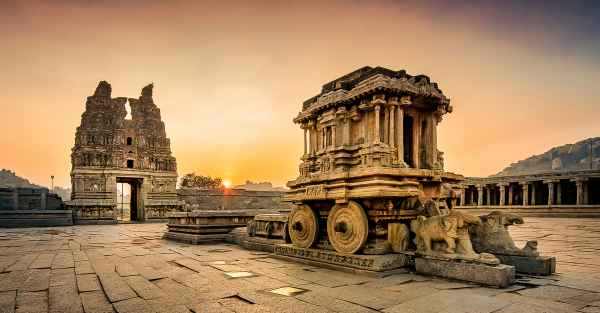
- Hampi, Karnataka – In the northern section of Karnataka the Hampi is a UNESCO World Heritage site. It is amidst the remains of Vijayanagar’s historic, rich kingdom. Hampi’s ruins are a collection of cultural monuments that depict the excellent Dravidian architectural style. The Virupaksha Temple, still a key religious centre for the Hindus, is the most important structure in this location. Many more monuments are part of this historical site; altogether they are known as the Hampi Monument Group. Some of the more well-known include the temple complex of Krishna, Narasimha, Ganesa, the temple group of Hemakuta, the complex of Achyutaraya Temple, the temple complex of Vitthala, the Temple of Pattabhirama Complex, and Lotus Mahal Complex.
You can contact to Hampi, Karnataka through website https://www.karnatakatourism.org
- Ajanta Caves, Maharashtra – The Ajanta Caves, one of Indian’s earliest World Heritage sites, dates to circa 650 CE and is made of 31 rock-cut Buddhist structures, murals, and sculptures. The grottoes are beautifully constructed in two stages. Satavahana Period of the Satvahana Dynasty First (230BCE-220CE). Second, the Vakataka cellars under the Vakataka dynasty reign of Emperor Harishena. The Ajanta style of building and art has had a revolutionary influence on the history of Indian art and architecture.
Art is an integral part of all its structures in this little town and is the traditional illustration of the elegance of Indian cultural and creative history. Khajuraho’s finest thing is that although many looters have tried to destroy the complete complex, they never succeed even when the number of temples and cellars was reduced to 25 from an astonishing 85 at the time they were built.
You can contact to Ajanta Caves, Maharashtra through website indiaculture.in
- Ellora Caves, Maharashtra – The Ellora Caves, which ranged 29 Km northwest of the town of Aurangabad, is a notable World Heritage Site in India and an archaeological site. The cave of Ellora is noted for its Indian-rock cuts. There are around 34 rock-cut temples and caves, dating from 600 to 1000 AD that is important for people’s lives these days. The presence of the temples and sculptures of Hindu, Buddhist, and Jain portrays the tolerance provided to diverse religions and creeds. The site is composed of Charanandri hills, Hindu Buddhist and Jain rocks, 5th and 10th Centuries vicars, and maths.
You can contact to Ellora Caves, Maharashtra through website https://whc.unesco.org and you can call on 0240 234 3169
- Bodh Gaya, Bihar – Bodh Gaya is almost 96 km from Patna in Bihar and is one of the UNESCO World Heritage Sites. The area where Mahatma Buddha attained the lights is a significant religious centre for Buddhists. Siddhartha became an illumination place and Gautama Buddha, the sacred Bodhi tree. In the time of Asoka the Great, the famed Mahabodhi Temple was set up around 250 BCE. This is a Buddhist temple of the oldest time. Today, Bodh Gaya Mahabodhi Temple Complex consists of Mahabodhi Temple 50 m high, Vajrasana, Bodhi Tree holy, and other six Buddha places, surrounded by many historic Votive Temples. Become the holiest place of pilgrimage for the Buddhists, Bodh Gaya is recognized for all of these reasons.
You can contact to Bodh Gaya, Bihar through website https://gaya.nic.in
- Sun Temple, Konark, Odisha – The Sun Temple at Konark is a temple from the 13 th century located in Konark, Odisha, not too distant from the city of the famed beach of Puri. It was erected approximately 1250 in the Eastern Ganga Dynasty by King Narasimhadeva I. The Sun Temple is in the form and is driven by six hugely graven horses, of a large cart including carved rollers, pillars, and walls. This is also regarded as one of India’s biggest shrines for Brahmin. Originally the temple was supposed to be erected near the mouth of the Chandrabhaga River. This Indian World Heritage Site shows the greatness of Kalinga’s traditional style that was then prevailing.
You can contact to Sun Temple, Konark, Odisha through website http://konark.nic.in/ and you can call on 0674-2432177
- Red Fort Complex, Delhi – Located in central New Delhi’s ancient city, Emperor Shah Jahan erected the Red Fort when he moved his capital city from Agra to Delhi or what at the time was called Shahjahanabad. The fort was the Mughal’s political headquarters. The art and architecture of Mughal achieved their zenith during Shah Jahan, and the Red Fort was the ideal embodiment of that. You can observe that there are several features of the Red fort integrating the Indo-Islamic, Taurid, Hindu, and Persian architectural traditions. It consists of red sandstone with other smaller structures, including the Diwan-i-aam, and the Diwan-i-Khas. It consists of various structures. The Red Fort is one of the UNESCO World Heritage Sites in India and is directly controlled by the Indian Archaeological Survey.
You can contact to Red Fort Complex, Delhi through website https://whc.unesco.org and you can call on 011 2327 7705
- Sanchi, Madhya Pradesh – In Sanchi, Madhya Pradesh, and the Buddhist Monuments are an example of India’s heritage and are the earliest stone buildings in India. The Stupa is located 46 kilometres to the northeast of Bhopal and was initially commissioned by Emperor Asoka in the 3rd century BCE. Its centre, erected on the relics of Buddha and worshipped by Charta, is symbolized by a hemispherical brick building. The stupa was vandalized and refurbished during the Satavahana period in the 2nd century BCE when the entrances and the railing were created and coloured. There are several other constructions, such as monolithic pillars, temples, churches, and monasteries, aside from Sanchi stupa. Until approximately the 12th century AD, religion waned in prominence, it remained a major pilgrimage site of Buddhism.
You can contact to Red Fort Complex, Delhi through website www.sanchi.org and you can call on 07482 266 611
- Chola Temples, Tamil Nadu – In the South, under the time of the Chola Empire, these temples were erected. The most notable of all these temples are the Brihadisvara Temple, Gangaikonda Cholapuram Temple, and Airavatesvara Temple. Under Rajaraja 1 the Brihadisvara temple represents a milestone in the architecture of Chola. Rupendra 1 was the patron saint of the shrine in Gangaikondakolapuram. And during the period of Rajaraja II, the temple of Airavatesvara was created and it differs aesthetically from the other two. The architectural splendor and grandeur of Chola’s art, architecture, and sculpture are witnessed through these temples. These temples are live temples and there remain ceremonies and feasts that people observed millennia ago. Those three temples, therefore, exhibit Tamil Tamil’s old cultures and traditions and constitute part of its ancient history.
You can contact to Red Fort Complex, Delhi through website www.wordheritagesites.org and you can call on 04362 274 476
- Kaziranga Wild Life Sanctuary, Assam – Kaziranga Wildlife Sanctuary is well known for its one-horn rhinoceroses and it is located in the city of Assam. It’s reported that Lord Curzon launched a study at this World Heritage Site in India that failed to find a single Rhinoceros in the area and urging her spouse to take steps to safeguard those endangered animals. The park is located in the Brahmaputra river floodplains and comprises mostly deep wilderness, forests, and various rivers and lakes. Kaziranga is home to around 15 endangered Indian species of animals, the most vulnerable of which is the Rhino. Other mammals include lingerie, hillock, leopard, Ganges, sloth, otter, juniper, guardian, sambar, swamp deer, and Indian manta. Other species include the capped langur and the wild boar.
You can contact to Kaziranga Wild Life Sanctuary, Assam through website https://www.kaziranga-national-park.com/ and you can call on (03672)279012
- Group of Monuments at Mahabalipuram, Tamil Nadu – The temples are located in the town of Mahabalipuram, about 58 km from Chennai on the Bay of Bengal’s Coromandel Coast. These temples were erected under the control of the monarchs of Pal lava, and their characteristic is that they were all made of rock and crucial for the architectural design of Ratho in India. The monument group consists of 40 sanctuaries, including Ganga’s Descente, the greatest open air-underground relief. The work of Pal lava with locations like Pancha Rat has, Dharamaraja Rathas, Arjuna Ratha, Draupadi Ratha, and so on forms part of this World Heritage site in India.
The Mahabalipuram Cave temples, which make up over half a dozen caverns. The Temples of Pancha Rathas, Ganesha Ratha, the Temples of Mahabalipuram Cave, the Temples of the Structural Temple, the Temple of Olakkannesvara Cave, and Ganges Descent.
You can contact to Group of Monuments at Mahabalipuram, Tamil Nadu through https://whc.unesco.org/en/list/249/ and you can call on 044 2744 2232
- Sundarbans National Park, West Bengal – The Sunder ban National Park is renowned as the Royal Bengal Tigers and a reserve for the biosphere in the Indian state of West Bengal. It is on the Sunder ban Deltas in the Bay of Bengal, created by the Ganges River. It is one of India’s biggest reserves, primarily covered by extensive mangrove forests. It is the largest forest reserve mangrove in the world. Numerous animal species, such as the Gangetic dolphin, spotted deer, wild boar, and other mammon and amphibian species are also located at the severely endangered Royal Bengal Tiger. Another highlight of this reserve is the unique saltwater crocodile. India’s tiger population is the highest here.
You can contact to Sundarbans National Park, West Bengal through website https://www.sunderbannationalpark.in
- Human’s Tomb, New Delhi – It was created by Begum Bega, Humayun’s initial wife from 1565 to 157 2, as a World Heritage site in India. IT is the only monument that has been renovated and completed many restorations. It is a grave complex made up of certain lesser structures, including the graves of Isa Khan Niyazi, a noble Afghan in the Suri dynasty courtyard of Sher Shah Suri.
You can contact to Human’s Tomb, New Delhi through call on 011 2435 5275
- Jantar Mantar, Jaipur, and Rajasthan – The Jantar Mantar is an astronomical observatory constructed in Rajasthan in the 18th century. The Rajput King Sawai Jai Singh of Rajasthan in 1738 CE established the Astronomical Observatory. It consists of 19 astronomical instrument collections, including the biggest Sundial stone in the world. They’re all man-made instruments. The observatory comprises instruments used for calculating the celestial coordinate systems, the local horizon-zenith, the equatorial system, and the ecliptic system. This monument is a great example of the science and the cultural legacy of India, one of India’s best-preserved observatories.
You can contact to Sundarbans National Park, West Bengal through website www.tourism.rajastham.gov.in
- Agra Fort, Uttar Pradesh – The Agra fort is one of the most prominent monumental buildings created by the Mughal dynasty, quite near to the Taj Mahal. The fortress of Agra was founded during the Mughal era and is a merging of the Timurid Persian art with the Indian architectural elements during the period of Akbar. It was because the fort was previously a Badalgarh brick structure, controlled by a Hindu king from Shikarwar Rajput, Raja Badal Singh. The first Delhi sultan to go to Agra, Sikander Lodi lived in the fortification, after the assault. In the Agra Fort there are structures such as Khas Mahal, Sheesh Mahal, Muhammad Buried, Dewan-e-Khas, Moti Masjid and Nagina Masjid.
You can contact to Red Fort Complex, Delhi through website nri.up.gov.in and you can call on 0562 222 6431
- Fathepur Sikri, Uttar Pradesh – The name Fatehpur Sikri, the name of the city itself, marks the victory (Fateh) of Akbar against Chittor and Ranthambore. The Jama Masjid, The Buland Darwaza, the main gateway in Asia, is built out of a special wood transported into the water from Australia. Panch Mahal or Jada Baai Ka Mahal, also known as the Navaratnas origin (Birbal, Tansen, etc.). The Diwan-e-Khas and Diwan-e-aim were also enclosed. The Tomb of Salim Chishti is situated inside the Buland Darwaza. The Mughal structures are all remarkable places in Indian history.
You can contact to Fathepur Sikri, Uttar Pradesh through website nri.up.gov.in
- Rani Ki Vav, Patan, Gujarat – It is a stunning example of exquisite Ancient Indian architecture, constructed until the third millennium BC in commemoration of the monarchs. Erected at the reign of the Solanki dynasty, the mythology states it was built by his widowed reindeer Udayamati to honor and remember Bhimdev 1, son of the family’s founder. Due to its architectural beauty and splendor, it was just named a UNESCO World Patrimony in 2014. Rani-ki-Stepped vav’s Corridors, Sculptures, and Stone Carvings in the Well are well-known. Most of Lord Vishnu’s sculptures in the well are in the shape of his 10 incarnations, indicating his return to the earth. This vav has spiritual importance aside from being a site for the storing of water. It is intended as an inverted temple and is split into seven levels of wells with their value as referred to in canonical texts in the religious and mythical writings.
You can contact to Rani Ki Vav, Patan, Gujarat through website https://www.gujarattourism.com
- Elephanta Caves, Maharashtra – In the Arab City on an island, not far from the city of Mumbai, the caverns of Elephanta are found. Gharapuri is also known as the network of sculptured caverns on Elephanta Island. Many archaeological remnants provide us an insight into Indian civilization’s rich cultural history. These cave sites are known for their sculptures and sculptures that show Shiva as the creator and destroyer of the universe. The main cave is Cave 1. At the entrance of the cellar, one can observe the sadachiva, showing the Creator, Preserver, and Destructor, three faces of Shiva. The groves are sculpted in solid granite and are located 10 kilometers east of Mumbai city.
You can contact to Red Fort Complex, Delhi through website https://whc.unesco.org and you can call on 022 2204 4040
- Nalanda Mahavihara (Nalanda University), Bihar – The archaeological site of Nalanda in Bihar was a study and Buddhist monastery from the 3rd century BCE to the 13th century CE. If you go around the campus, which is a representation of a golden era you may view the remnants of stupas, shrines, and viharas. For 800 years Nalanda asserted that Buddhism has evolved as a religion and remained a place of knowledge. Students from Tibet, China, Korea, and Central Asia formerly attended the World’s first residential university, known for its formalized Vedic study. This is the second UNESCO World Heritage Site in Bihar itself, which has made it even more famous on the Indian Tourism Map.
You can contact to Red Fort Complex, Delhi through website https://www.nnm.ac.in/ and you can call on 09905471498
FAQs About India’s Heritage Sites:
1. Q: What are some must-visit heritage sites in India?
A: Embark on a cultural voyage through India’s past by exploring iconic heritage sites like the Taj Mahal, Hampi, and Khajuraho Temples.
2. Q: How do heritage sites reflect India’s cultural diversity?
A: Heritage sites in India offer a glimpse into the nation’s cultural mosaic, displaying architectural styles, artistry, and traditions from various regions and eras.
3. Q: Are these heritage sites only of historical importance?
A: Beyond their historical significance, these sites hold immense cultural value, narrating stories of dynasties, spirituality, and artistic brilliance that shaped India’s identity.
4. Q: Can I capture the essence of India’s heritage through its architecture?
A: Absolutely! The intricate designs, majestic palaces, and sacred structures within these heritage sites epitomize India’s architectural prowess and its devotion to aesthetics.
5. Q: How can heritage sites contribute to tourism and education?
A: Heritage sites not only attract tourists but also serve as open-air classrooms, offering invaluable insights into history, art, and the socio-cultural evolution of India.
6. Q: Are these heritage sites well-preserved and accessible?
A: Efforts to preserve and maintain these sites are ongoing, with many being easily accessible to visitors. However, some remote sites might require special arrangements to explore their hidden wonders.