Address: Mumbai, , , 400053
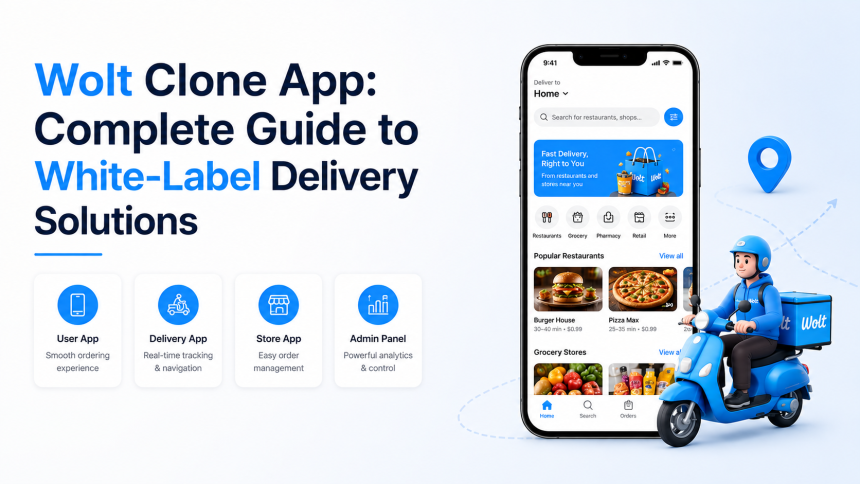
The food delivery industry has changed significantly as customers increasingly prefer ordering meals, groceries, and everyday products through mobile applications. This shift has created new opportunities for entrepreneurs to launch digital delivery businesses without building every component from scratch. A Wolt Clone App provides a ready-made foundation for creating an on-demand delivery platform inspired by the core functionality of popular services such as Wolt.
A Wolt-like platform can connect customers, restaurants, stores, delivery partners, and administrators through a single digital ecosystem. Depending on the business strategy, the platform can support food delivery, grocery delivery, local shopping, courier services, and other on-demand services.
A white-label delivery solution makes this approach more flexible because businesses can customize the application with their own brand identity, features, pricing structure, service areas, and business rules. Instead of starting development from zero, entrepreneurs can use an existing solution as a foundation and adapt it to their target market.
This guide explains what a Wolt Clone App is, how it works, its important features, benefits, business models, development considerations, monetization opportunities, and future possibilities.
A Wolt Clone App is a ready-to-customize food and delivery application designed to provide functionality similar to a modern on-demand delivery platform.
It typically includes separate interfaces for:
Customers
Restaurants or vendors
Delivery partners
Administrators
Customers can browse nearby restaurants or stores, view products, place orders, make payments, and track deliveries. Vendors can manage menus, prices, orders, availability, and earnings. Delivery partners can accept delivery requests, navigate to pickup locations, and complete deliveries.
The administrator manages the overall ecosystem, including users, vendors, drivers, commissions, payments, promotions, service areas, and reports.
The goal is not simply to copy another company's application. Instead, a clone app provides a proven functional foundation that can be customized into a unique delivery business.
Building an on-demand delivery platform completely from scratch can require considerable time, technical expertise, testing, and investment. A white-label solution can reduce the amount of initial development work by providing many essential components in advance.
A business can customize elements such as:
Logo and brand identity
Application design
Color schemes
Service categories
Vendor management
Delivery zones
Commission structure
Payment options
Promotional campaigns
Delivery charges
Admin controls
This makes white-label software particularly useful for startups and businesses that want to enter the delivery market quickly.
A well-designed solution should also allow future customization so the business can introduce new services and features as it grows.
A typical Wolt-like delivery ecosystem follows a straightforward process.
Customers register through the application and enter their delivery location. They can browse available restaurants, stores, products, or services.
After selecting items, they add them to the cart and proceed to checkout.
The restaurant or store receives the order through its vendor application or dashboard. The vendor confirms the order and begins preparation.
After the order is ready, the platform assigns it to an available delivery partner. Depending on the system, drivers may also be able to accept delivery requests themselves.
The delivery partner navigates to the restaurant or store and collects the customer's order.
Real-time tracking allows customers to monitor the delivery partner's location and estimated arrival time.
The delivery partner reaches the customer's location and completes the order. The platform then updates the order status and records the transaction.
A successful delivery platform requires features that serve every participant in the ecosystem.
Customers should be able to create accounts using common registration methods such as email, phone number, or social login.
GPS and location services can help identify nearby restaurants, stores, and delivery options.
Customers should be able to search restaurants and filter results based on cuisine, price, ratings, delivery time, and other criteria.
Each vendor should have a detailed catalog containing:
Product names
Images
Descriptions
Prices
Variations
Add-ons
Availability
Customers can review selected items, adjust quantities, apply discounts, and see the estimated total before checkout.
A delivery platform can support different payment methods depending on the target market, including:
Credit and debit cards
Digital wallets
Online banking
Cash on delivery
Regional payment solutions
Real-time tracking gives customers visibility into the status and location of their delivery.
Customers can rate restaurants, products, and delivery experiences. This feedback can help improve service quality and customer trust.
Notifications can inform customers about:
Order confirmation
Preparation status
Driver assignment
Pickup
Delivery progress
Promotional offers
Restaurants and stores need their own tools to manage daily operations.
Businesses can submit their information and required documents for approval.
Vendors can add, update, remove, or temporarily disable products.
Vendors can accept or reject orders, update preparation status, and communicate relevant information to customers or drivers.
Businesses can update prices, add variations, and create special offers.
Vendors can mark products as unavailable when inventory is limited.
A vendor dashboard can display:
Total sales
Completed orders
Pending orders
Commissions
Net earnings
Performance reports can help vendors understand popular products, order volume, customer ratings, and sales trends.
The driver application is an important component of an on-demand delivery platform.
Drivers can create profiles and submit required information for verification.
Drivers can indicate whether they are available to receive delivery requests.
Available drivers can view relevant order details before accepting a delivery.
Integrated maps help drivers navigate between pickup and delivery locations.
Drivers can view completed deliveries, earnings, bonuses, incentives, and payment history.
A history section allows drivers to review previous orders and completed trips.
Drivers can update order progress, such as:
Accepted
Arrived at vendor
Picked up
On the way
Delivered
The admin panel provides centralized control over the entire platform.
Administrators can manage customer accounts, vendor accounts, and delivery partners.
Admins can approve businesses, manage categories, review documents, and monitor vendor performance.
The platform can manage driver profiles, verification, availability, earnings, and delivery activity.
Administrators can monitor current and completed orders and resolve delivery issues.
The admin can define commission rates for vendors or delivery partners according to the business model.
Admins can create:
Coupons
Promo codes
Discounts
Referral campaigns
Promotional banners
A centralized dashboard can provide information about:
Orders
Revenue
Customers
Vendors
Drivers
Commissions
Popular locations
Popular products
These insights help business owners make data-driven decisions.
Using a ready-made delivery solution can reduce the time required to launch compared with developing a complete platform from the ground up.
A white-label platform can be adapted to different markets and service categories.
Businesses can generate revenue through commissions, delivery fees, advertising, subscriptions, and other models.
A properly designed application can be expanded as the number of customers, vendors, and delivery partners increases.
A food delivery platform can later expand into groceries, pharmacies, convenience stores, courier services, and other categories.
Features such as real-time tracking, digital payments, personalized recommendations, and notifications can improve customer convenience.
Before launching the platform, entrepreneurs should determine how the application will generate reven

Upto 6 month of service

100% certified professionals

Upto $5,000 against damages
Copyright © 2024 Digital Marketing Deal. All rights reserved.