
Address: 611, Shivalik Square, Near Adani CNG pump, Ramapir Thekra, Old Wadaj, Ahmedabad, Gujarat, 380013
Picture a typical evening in an Indian household. Dinner is on the stove, a phone sits on the counter, and someone says, "Order the same cooking oil we bought last time." No search bar, no filters, no scrolling through product pages. A voice assistant confirms the brand and price, adds it to the cart, and places the order before the vegetables are done.
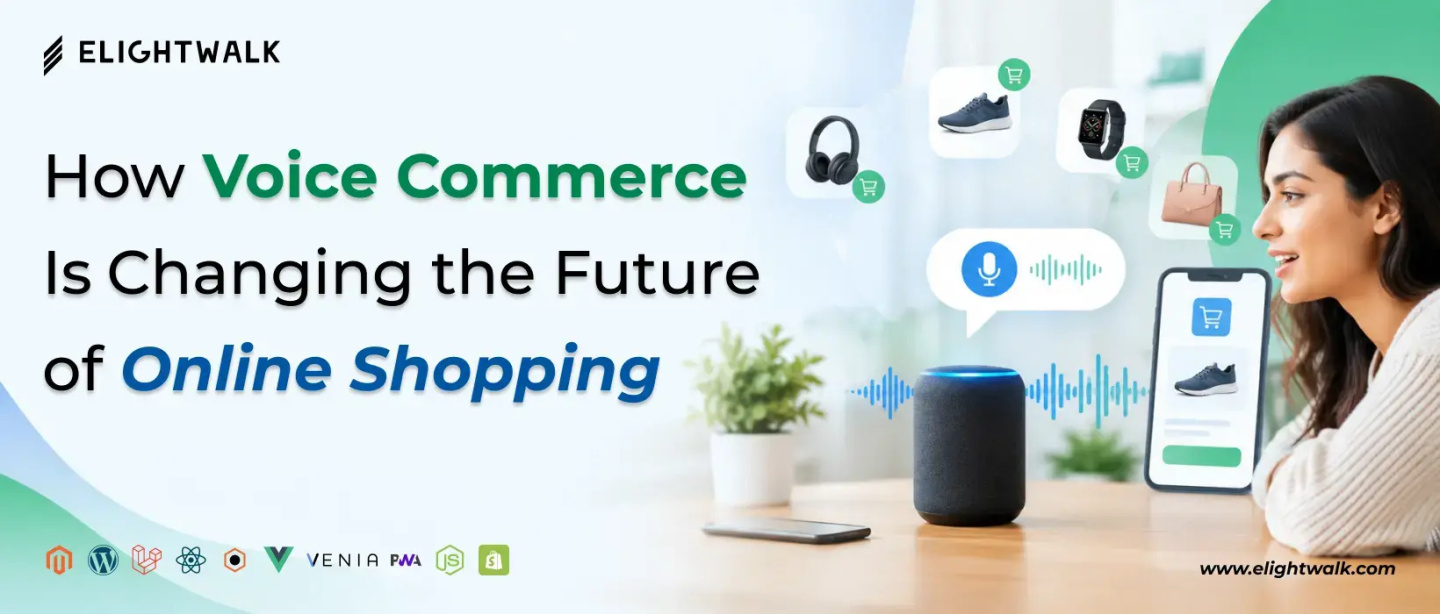
That short exchange is a small preview of voice commerce — shopping through conversation instead of clicking. And it's quietly moving from a novelty to a habit.
For online sellers, digital marketers, and business owners, this shift raises practical questions. What exactly is voice commerce? Why are shoppers taking to it? And what should a business do today so it isn't playing catch-up tomorrow? This article answers those questions — and points you to a detailed resource if you want to go deeper.
Voice commerce is the ability to search for, compare, and buy products using spoken commands instead of typing and tapping. A customer speaks to a voice assistant — on a phone, a smart speaker, or inside an app — and the system interprets the request, finds relevant products, and supports actions like adding items to a cart or reordering a previous purchase.
It helps to separate three terms that often get mixed up:
Also worth clearing up a common fear: voice commerce is not about replacing your website or app. Screens still matter, especially for products people want to see and compare. Voice is an additional layer — a more convenient front door to the same store you already run.
A few behaviors explain the growing pull of voice-based shopping:
It fits real life. People shop while cooking, cleaning, commuting, or managing kids. Voice works in those moments when both hands are occupied.
One sentence replaces five filters. Typing "running shoes" and then applying filters for size, color, price, and brand takes effort. Saying "find me black running shoes in size 9 under ₹3,000" communicates it all at once.
Reordering becomes effortless. For routine purchases — groceries, toiletries, pet food, medicines — nobody enjoys digging through order history. "Reorder my coffee" is faster than any app flow.
Speaking is more natural than typing queries — especially in India. Millions of users are more comfortable speaking Hindi or a regional language than typing in English. Voice interfaces lower that friction in a way search boxes never quite have.
AI has made the conversations smarter. Modern assistants remember context. You can ask a follow-up like "which one has better battery life?" without repeating your original question.
When a customer speaks to a store, a chain of technologies quietly does the work:
That last point is where many businesses underestimate the effort. A voice interface is only as good as the product data, search, and commerce systems behind it. If you want a proper, step-by-step walkthrough of this entire flow — from speech recognition to checkout — Elightwalk's guide on how voice commerce is changing the future of online shopping explains it clearly, with examples that make the technical parts easy to follow.
Earlier voice features worked like a command line: short, rigid instructions. That's changing fast.
Today, a shopper can say, "I need headphones for work-from-home, with a good mic, under ₹5,000," and an AI-powered system can unpack several requirements from a single sentence — then keep the conversation going: "Which one has the best microphone?" "Does it have noise cancellation?"
Two related developments are worth watching:
AI shopping assistants. Beyond search, these can compare products, answer questions about compatibility or delivery, and guide a shopper from discovery to decision—much like a knowledgeable in-store assistant.
Agentic commerce. An emerging idea where AI agents handle multi-step tasks on a customer's behalf—say, finding an office chair under ₹15,000 and comparing options. It's promising, but it also raises fair questions around authorization, transparency, and security that businesses will need to answer carefully.
Here's where voice commerce stops being an interesting trend and becomes a practical consideration for your business.
Search queries are getting longer and more conversational. Voice searches are phrased as questions: "which laptop is best for graphic design," "is this jacket good for winter?" Your product pages, FAQs, and buying guides should answer real customer questions in natural language — not just target short keywords.
Product data becomes your storefront. A voice system can only recommend what it can understand. Complete product names, accurate attributes (size, material, color, compatibility), current pricing, and structured data are what make a catalog voice-ready.
Site search deserves real investment. Voice conversations eventually hit your internal search. If your search returns poor results for a clearly stated requirement, the fanciest voice front-end won't save the experience.
Local businesses get a voice angle too. "Near me" queries are already common in voice search. Businesses listed on directories with accurate names, categories, and contact details are better positioned for these spoken searches.
No trend discussion is complete without the caveats — and voice commerce has a few real ones:
None of these are dealbreakers. They're simply the difference between a thoughtful implementation and a gimmick.
You don't need to tear down your existing store. A sensible starting sequence:
Businesses that want to go further — actually implementing voice or AI capabilities on platforms like Magento, Shopify, or a custom storefront — will find the preparation roadmap in the Elightwalk guide particularly useful, since it also covers how to build on existing infrastructure instead of replacing it.
Is voice commerce the same as voice search?
No. Voice search is looking things up by speaking. Voice commerce covers the full buying journey — discovery, comparison, cart, and purchase — through voice.
Do small businesses need to care yet?
Yes, but proportionately. You don't need a voice app tomorrow. Start with conversational content, clean product data, and accurate business listings — all of which help you today and prepare you for voice later.
Will voice replace websites and apps?
Unlikely. The future is multimodal: customers may start with voice, compare on a screen, and buy wherever it's most convenient.
Is voice commerce relevant in India?
Increasingly, yes — driven by affordable smart speakers, voice-first features in shopping apps, and millions of users who prefer speaking their own language over typing English.
Voice commerce isn't a gimmick. It's the shopping interface moving closer to how humans naturally communicate. The businesses that benefit most won't be the ones that panic-rebuild everything, but the ones that start with the basics — better product data, question-answering content, stronger search — and add voice where it genuinely reduces friction for their customers.
If you want a complete, well-structured exploration of this shift — including how the technology works, where AI is taking it, and a practical preparation roadmap for online stores — read Elightwalk's detailed guide on voice commerce and the future of online shopping.

Upto 6 month of service

100% certified professionals

Upto $5,000 against damages
Copyright © 2024 Digital Marketing Deal. All rights reserved.