
Address: Plot No. - 43, Sector - 3, IMT Manesar, Haryana - 122050, India, Gurgaon, Haryana, 122050
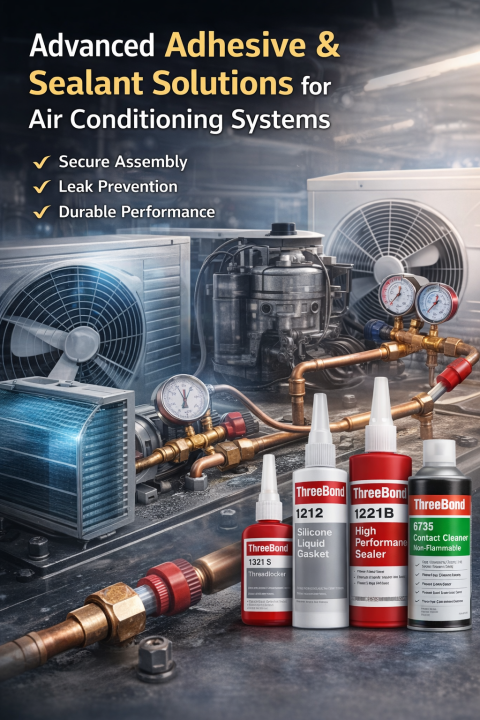
Air conditioning systems are essential components in modern buildings, vehicles, and industrial environments. From residential HVAC units to complex commercial cooling systems, air conditioners rely on multiple mechanical and electrical components working together efficiently. Ensuring durability, leak prevention, and vibration resistance is critical for long-term performance. This is where high-performance adhesive and sealant technologies play an important role.
Advanced bonding and sealing materials help manufacturers and service technicians improve reliability, reduce maintenance, and enhance energy efficiency in air conditioning systems. Industrial adhesive solutions are widely used to secure components, seal joints, prevent refrigerant leakage, and protect electronic modules inside HVAC equipment.
Air conditioning systems operate under challenging conditions. Components experience temperature fluctuations, pressure variations, vibration, and exposure to refrigerants and oils. Traditional mechanical fastening methods alone may not provide sufficient sealing or vibration resistance in such environments.
High-performance adhesives and sealants offer several advantages in AC manufacturing and maintenance:
Strong bonding between metal, plastic, and composite components
Reliable sealing to prevent refrigerant leakage
Protection against moisture, corrosion, and environmental contaminants
Resistance to vibration and thermal expansion
Improved durability of electrical and electronic components
By integrating advanced adhesive technologies, HVAC manufacturers can improve the overall reliability and efficiency of cooling systems.
Air conditioning units consist of multiple components that benefit from specialized bonding and sealing materials. Adhesives are used across several parts of the system to improve structural stability and sealing performance.
The compressor is the heart of an air conditioning system. It compresses refrigerant gas and circulates it through the system. Due to constant vibration and pressure changes, compressor components require strong sealing and fastening solutions.
Adhesive sealants are commonly used to:
Seal compressor housings
Prevent refrigerant leakage
Secure bolts and threaded fasteners
Protect against oil and chemical exposure
Threadlocking adhesives help prevent bolts from loosening under vibration, ensuring stable compressor operation.
Condensers and evaporators play a key role in heat transfer within an AC system. These components contain complex metal tubing and fins that require precise assembly and protection.
Adhesives and sealants are used for:
Sealing joints in refrigerant lines
Bonding metal components
Preventing corrosion and leakage
Enhancing structural strength of heat exchanger assemblies
Durable bonding materials ensure these components remain sealed and efficient over long operational periods.
Refrigerant pipes carry high-pressure gas and liquid throughout the cooling system. Even minor leaks can significantly reduce efficiency and increase operational costs.
Industrial sealants are applied to:
Pipe joints and fittings
Flanged connections
Threaded fittings
Metal-to-metal sealing surfaces
These materials help prevent refrigerant leakage and maintain system performance.
Modern air conditioning systems include electronic control boards, sensors, and electrical modules that manage temperature, airflow, and compressor operation.
Adhesives play an important role in protecting these sensitive components by:
Providing insulation
Securing electronic components
Protecting circuits from moisture and vibration
Improving durability of PCB assemblies
Specialized potting and encapsulation materials can also be used to protect electronics from environmental stress.
Various adhesive and sealant technologies are used in HVAC manufacturing depending on the application requirements. Each type offers specific performance characteristics.
Anaerobic adhesives are widely used for threadlocking and sealing metal components. They cure in the absence of air when confined between metal surfaces.
These adhesives are ideal for:
Locking compressor bolts
Sealing threaded pipe fittings
Preventing vibration loosening
Providing leak-proof sealing
Silicone-based sealants offer excellent flexibility and temperature resistance. They are commonly used for sealing HVAC components exposed to temperature variations.
Key advantages include:
High temperature resistance
Excellent flexibility
Strong adhesion to metals and plastics
Long-term durability
Epoxy adhesives provide strong structural bonding and chemical resistance. They are often used where high mechanical strength is required.
Applications include:
Bonding structural components
Securing metal assemblies
Protecting components exposed to refrigerants and oils
UV adhesives are used in applications requiring rapid curing and precision bonding, particularly in electronic modules and small components.
Modern adhesive solutions offer several benefits that improve AC system performance and manufacturing efficiency.
Adhesives distribute stress evenly across bonded surfaces, reducing the risk of mechanical failure. This improves long-term system reliability.
Proper sealing prevents refrigerant leaks, which can reduce cooling efficiency and increase operational costs.
Air conditioning compressors generate continuous vibration. Adhesives help secure fasteners and maintain joint integrity.
Durable bonding and sealing materials minimize the need for frequent repairs and maintenance.
Using adhesive technologies can reduce the need for additional mechanical fasteners, simplifying assembly processes.
Adhesive and sealant solutions are used in various types of air conditioning equipment, including:
In residential HVAC units, adhesives are used to seal pipe connections, secure electrical components, and protect internal parts from vibration and environmental exposure.
Vehicle air conditioning systems operate under demanding conditions such as engine vibration and temperature fluctuations. Adhesives help secure components and maintain leak-free operation.
Large commercial cooling systems require high-performance sealing solutions for compressors, heat exchangers, and refrigerant lines.
Industrial refrigeration and cooling equipment require durable adhesives capable of withstanding harsh operating environments.
The HVAC industry is continuously evolving with new materials and technologies designed to improve efficiency and sustainability. Adhesive manufacturers are developing advanced formulations to meet these changing requirements.
Some emerging trends include:
High-temperature resistant adhesives for advanced compressors
Environmentally friendly adhesive formulations
Improved materials for refrigerant compatibility
Advanced sealing technologies for energy-efficient systems
These innovations will continue to enhance the performance and reliability of air conditioning systems.
Adhesives and sealants have become essential components in modern air conditioning systems. From securing compressors and sealing refrigerant pipes to protecting electronic components, these materials play a critical role in ensuring system reliability and efficiency.
By using advanced bonding and sealing technologies, HVAC manufacturers can improve durability, reduce maintenance requirements, and enhance overall cooling performance.
As the demand for efficient and reliable cooling systems continues to grow, high-performance adhesive solutions will remain a key factor in the development of next-generation air conditioning equipment.

Upto 6 month of service

100% certified professionals

Upto $5,000 against damages
Copyright © 2024 Digital Marketing Deal. All rights reserved.